
E-commerce site for a boutique brand: opening your own store next to the marketplace
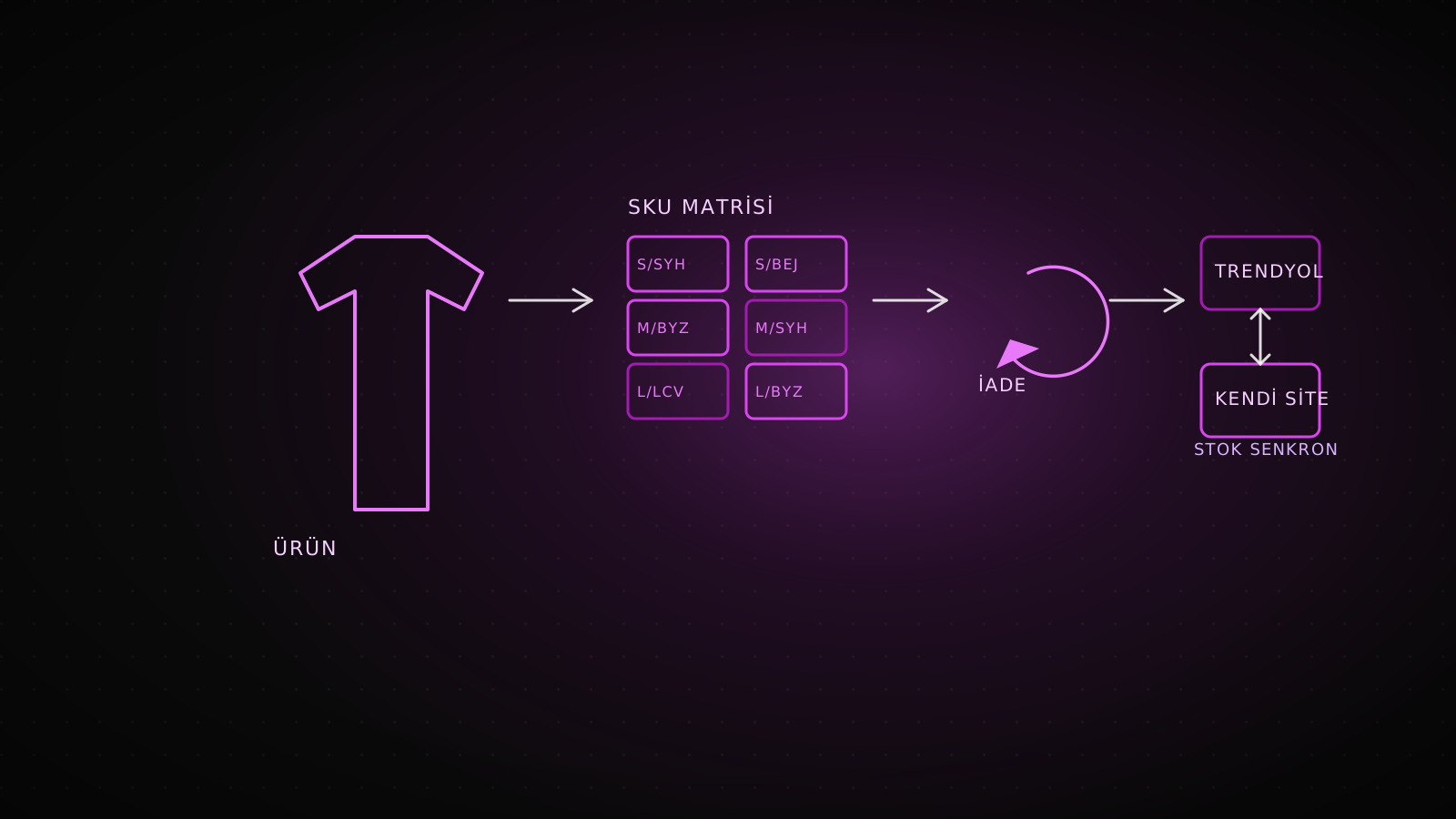
A boutique brand's own e-commerce site isn't a platform choice. It's whether three parts are ready: the variant schema, the return workflow, and stock sync.
A boutique brand opening its own e-commerce site next to a marketplace listing isn't a platform choice. It's whether three parts are ready: the product variant schema, the return workflow, and stock sync between the two channels. A site launched without those three collects customer data but produces chaos in the warehouse, you end up counting how many of which size in which color are left in two separate systems. The right order follows the design of those three parts, not the catalog's size.
Summary
A boutique brand's own e-commerce site isn't a storefront built to dodge marketplace commission. It's an operation with three parts to design: a size/color variant schema at the SKU level, the return workflow a marketplace normally runs automatically, and stock sync between the two channels. Launch without those three and the site collects customer data while creating chaos in the warehouse.
The real risk of launching your own store isn't code, it's the variant schema
For a boutique brand trying to escape marketplace commission, "launching your own store" usually sounds like building a storefront: product photos, cart, checkout. That isn't where the difficulty lives. A clothing brand's catalog isn't one product per listing, it's as many SKUs as size multiplied by color; each SKU carries its own stock count, its own barcode, and its own reconciliation line when a return comes in. On a marketplace, the platform already built that schema, the brand just adds products. On its own site, the brand has to design that schema from scratch, and a variant schema built wrong is one of the most expensive things to migrate later.
Setting up size and color variants at the SKU level
The most common mistake is squeezing variants into a single "stock count" field, a record like "Blue Dress, 40 units" that doesn't separate size from color, which makes it impossible to see which size actually sold out. The right schema defines every size-color combination as its own SKU.
Example SKU matrix: 3 sizes × 4 colors = 12 SKUs
Each cell is its own SKU: its own stock count, its own barcode, its own reconciliation line when a return comes in. One product in 3 sizes and 4 colors is already 12 separate stock records; the matrix grows multiplicatively as the catalog does.
As this matrix grows, getting the "out of stock in your size" warning to show at the right moment becomes the brand's responsibility, not the platform's. Skip designing the schema at the SKU level from the start, and stock reconciliation comes back as a separate problem, especially for brands running on consignment.
Designing the return workflow: what the marketplace used to handle is now on the brand
When a customer opens a return request on a marketplace, the flow runs on the platform's standard rules: a shipping label, a time window, a return approval, a notification to the brand. On its own site, the brand has to define every step of that flow itself: where the request lands, who checks the item's condition, when the right SKU's stock count goes back up, and which gateway triggers the refund and how fast. Returns run higher in apparel than in most other categories; a return request that gets lost in a manual process is lost customer trust, not just a lost sale.
A real build: Hiera and Loom & Loop
Hiera, a premium fixtures brand, runs products, variants, stock, orders, returns, and coupons from one admin screen, with 10 different triggered email templates that notify customers automatically on restock or a price drop. At Loom & Loop, a Netherlands-based slow-fashion brand, the post-checkout process (shipping notices, newsletter) runs on automation rather than manual handling, so a return request enters the flow without waiting on a person.
Source: the Hiera and Loom & Loop builds.
How variants, returns, and stock work on a marketplace versus your own site
| Topic | Marketplace | Your own site |
|---|---|---|
| Variant tracking | The platform maps SKUs by its own rules, the brand sees a limited view | The schema belongs to the brand, full control at the code level |
| Return workflow | The platform's standard flow; the brand just gets notified | A flow the brand designs from scratch: request, inspection, reconciliation, refund |
| Stock source | Synced through the platform's own panel | An ERP or the brand's own admin becomes the single source of truth |
| Customer data | Belongs to the platform, limited brand access | Belongs to the brand, usable for marketing and retention |
The table isn't a preference ranking, the right column is the responsibility list the brand now has to build itself. Launch without that list in place, and the site loses the marketplace's convenience without yet gaining the control in the right column.
Are you ready to launch your own store: an operational checklist
Is the variant schema defined at the SKU level
Does every size-color combination carry its own barcode and stock count, or is it collapsed into a single "stock count" field
Is it clear who does what in the return flow
Where the request lands, who checks the item's condition, and at which step stock and refund actually trigger
Is there a single source of truth for stock
If the marketplace and your own site sell at once, which system's stock count counts as real, and does the other feed off it
Is it defined where customer data lives
Does order and contact data stay on your own site, who can access it, and how it feeds marketing
If the answer to all four isn't yes yet, launching isn't premature, it just means the build order for these four isn't settled. For most brands the order starts with digitizing the catalog, the variant schema and return flow get designed together, and stock sync comes in last.
When this investment isn't needed yet
If the catalog is under 20 products and monthly orders are still in the single digits, building a full variant schema and a dedicated return flow is an investment that doesn't pay off yet. In that case, staying on the marketplace and treating commission as a customer acquisition cost works out cheaper than building a store and leaving it idle. The investment starts making sense once variant count and return volume outgrow manual tracking, or once the brand's own traffic (an Instagram following, repeat buyers) can feed a channel outside the marketplace.
Frequently asked questions
Which part should get built first when launching your own store?
The variant schema. The return workflow and stock sync stay half-finished without a clear definition of what each SKU is; the order starts with defining the variant schema at the SKU level.
Can I launch my own site without leaving the marketplace?
Yes. Both channels can run in parallel; what matters is defining upfront which system counts as the single source of truth for stock, otherwise the two panels show different numbers.
Can the variant schema be fixed later if it's built wrong?
It can, but restructuring SKUs once they're tied to barcodes and order history takes longer than building it right the first time, especially for brands running on consignment, where stock reconciliation carries extra risk during that fix.
Does a high-return category need anything extra?
Since returns run higher in apparel than in most categories, having the flow (request, inspection, reconciliation, refund) run on defined steps rather than manually matters more, even for brands with a small order volume.
WooCommerce or Next.js, which handles variants better?
Both support a SKU-level variant schema. Which one fits depends on catalog size and how many marketplaces need to stay in sync, a decision we cover in our e-commerce website cost guide.
These three parts get built together under a WooCommerce e-commerce or Next.js e-commerce scope. We broke down the real cost of marketplace commission by category in our Trendyol apparel commission guide; to see your own breakeven point, try the marketplace vs. your own store cost comparator.
Related solutions
Let's talk about what you want built.
Tell us what you want to build and we will work the scope out together.
Ask an AI about Lumiasoft
The question is ready. Let the tool read the site and answer for itself.


