
E-commerce ERP integration for B2B sellers: keeping stock, orders and invoices in sync
When stock lives in a spreadsheet, orders in email and invoices in a separate screen, the three records are never right at the same time. What ERP integration actually does, ready-made connectors vs a custom API, and what changes for wholesale and export sellers.
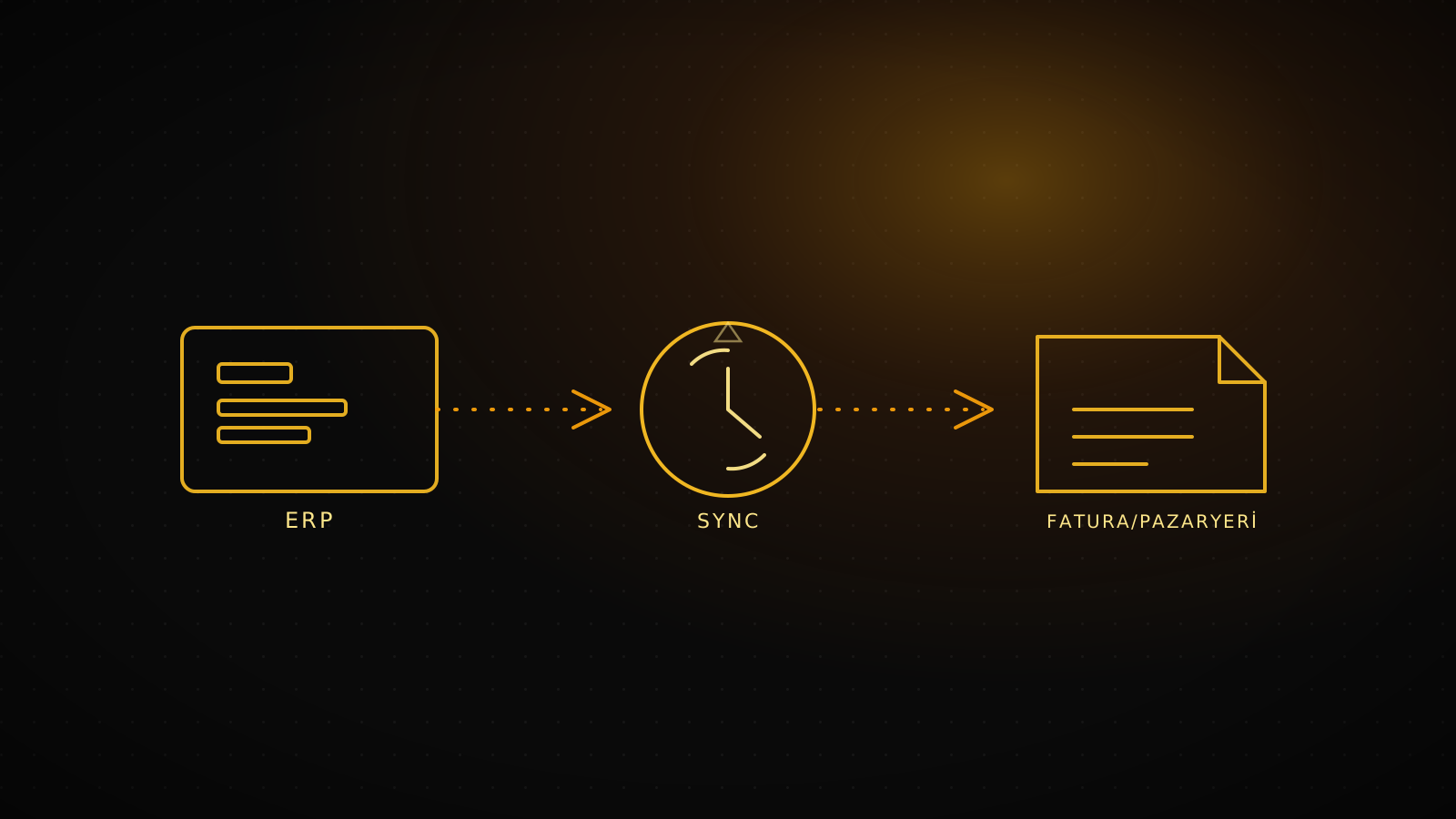
E-commerce ERP integration means building a setup where stock, order and invoice data flows automatically and both ways between one source of truth, the ERP, and everywhere else: the website, the marketplace, the accounting system. There are two paths to build it: a ready-made connector for a common ERP like Logo, Mikro, Netsis or Zirve, or a custom API integration built on webhooks and a queue. Wholesale and export sellers add a third layer on top: matching each order to the right account (cari) and staying compliant with e-invoice/e-archive rules, because a gap here breaks the accounting record, not just a stock count.
Summary
A standard scope (stock, price, order, invoice sync) goes live in 2-3 weeks; complex catalog transformations or multi-warehouse setups stretch to 4-6 weeks. A ready-made connector works in days on a common ERP like Logo, Mikro, Netsis or Zirve but can't step outside its template; a custom API integration takes longer but can be shaped around account matching and e-invoice rules. Either way, a webhook is never treated as a reliable one-shot event without retry and a dead-letter queue.
What the three disconnected systems actually cost
A wholesale or export seller usually keeps stock in the ERP, orders in email and spreadsheets, and invoicing on a separate accounting screen. Without sync, the same three mistakes repeat: the same product shows two different stock counts in two systems, a manually entered order gets a line skipped or mistyped and throws off the account balance, and invoicing happens days after the order closes, which makes cash-flow forecasting unreliable. These look like three small, unrelated mistakes, but they share one root cause: no system is defined as the single source of truth.
What ERP integration technically does and which system owns which data
The first job of an integration is an ownership decision: the ERP becomes the source of truth for stock and price, and the website or marketplace become derivatives of it. For orders, the direction reverses: an order placed on the marketplace or the site flows into the ERP through a webhook. In Lumiasoft's own sync architecture, order events (order.created, order.cancelled, order.returned) land in a queue, get processed with idempotency keys, and write to the ERP; every webhook is protected by three retry attempts and a dead-letter queue, because marketplace webhooks are never 100% reliable.
The integration's data flow
1. ERP is the source of truth
Stock and price are set here, every other system is a derivative.
2. Webhook capture
An order on the marketplace or site triggers instantly.
3. Queue + idempotency
3 retries plus a dead-letter queue, no event gets lost.
4. ERP and invoice update
Stock decrements, the account posts, the e-invoice generates.
The same shape as the architecture behind Lumiasoft's own marketplace stock sync, generalized to any ERP.
Ready-made connector or custom API: which one, when
A ready-made connector sets up in days on a common ERP like Logo, Mikro, Netsis or Zirve, but it can't step outside its template: a specific account-matching rule, a non-standard SKU taxonomy or a second marketplace channel strains it fast. A custom API integration takes longer to build, but every rule, account matching, invoice format, multi-warehouse logic, gets built around how the business actually works.
| Criteria | Ready-made connector | Custom API integration |
|---|---|---|
| Setup time | Days, fixed template | 2-6 weeks, scope-dependent |
| ERP coverage | Only supported ERPs | Any ERP or custom schema |
| Account/invoice rules | Fixed template, no changes | Built around the business's own rule |
| Observability | Depends on the connector vendor | Own retry/DLQ and log dashboard |
| When it fits | Single channel, simple catalog | Multi-channel, custom account/invoice rule |
What changes for B2B and export sellers: account matching and e-invoice compliance
For a wholesale or export seller, integration doesn't end at decrementing stock. Dealer- and customer-specific price lists need to map to the right account code, or the ERP's receivable balance stops matching the real order. Businesses under e-invoice or e-archive obligations need invoices generated automatically through the official GİB integration; whether that obligation applies to a specific business, under current thresholds and exceptions, should be confirmed from GİB's own current notices, which this article does not substitute for.
Truexim: a digital operations build for a foreign-trade firm
Intranet
A separate module built for internal process work.
Mail automation
Standardized quote and customer workflows.
Lighthouse
96 mobile, 100 desktop, 100 SEO.
Source: Truexim's digital operations platform. An international search module tracks business opportunities across countries from one panel.
What to watch for during setup: the mistakes that get expensive
The three most common mistakes: treating a webhook as a reliable one-shot event (Lumiasoft's own measured marketplace webhooks fail roughly 0.2% of the time; without retry and a dead-letter queue, those events disappear silently), leaving account matching for the end of the project (which lets stock sync run fine while the accounting record comes out wrong), and going live with no dashboard watching the sync. Last successful sync time, queue depth, failed-event count and the ERP-to-marketplace stock diff need to be visible, or drift gets caught by a customer complaint instead of a dashboard.
Is there a case where this integration isn't worth it yet
A seller on a single channel, with low monthly order volume, where manual entry isn't actually producing errors yet, may find a custom API integration an unnecessary investment for now; a ready-made connector or the current process stays good enough a while longer. The point where integration pays for itself usually arrives once volume grows or a second sales channel gets added; there's no need to pull the investment earlier than that.
Which path fits is usually clear once the current ERP, channel count and account/invoice rule get scoped in a discovery call for integration scope; the same architecture also prevents the problems covered in the marketplace integration error guide.
Frequently asked questions
How long does e-commerce ERP integration take?
A standard scope (stock, price, order, invoice sync) goes live in 2-3 weeks. Complex catalog transformations or multi-warehouse setups stretch to 4-6 weeks.
Which ERPs get integrated?
Production integrations exist for Logo, Mikro, Netsis and Zirve. Less common ERPs get scoped during the discovery call.
Is a ready-made connector enough?
Usually, for a single channel and a simple catalog. A custom account-matching rule, multi-channel selling or a non-standard SKU structure needs a custom API integration instead.
Does this include e-invoice/e-archive integration?
Yes, automatic e-invoice/e-archive generation through the official GİB integration can be added to scope. Whether the obligation applies to your business should be confirmed from GİB's own current notices.