
Contractor website pricing: which line items actually move the quote
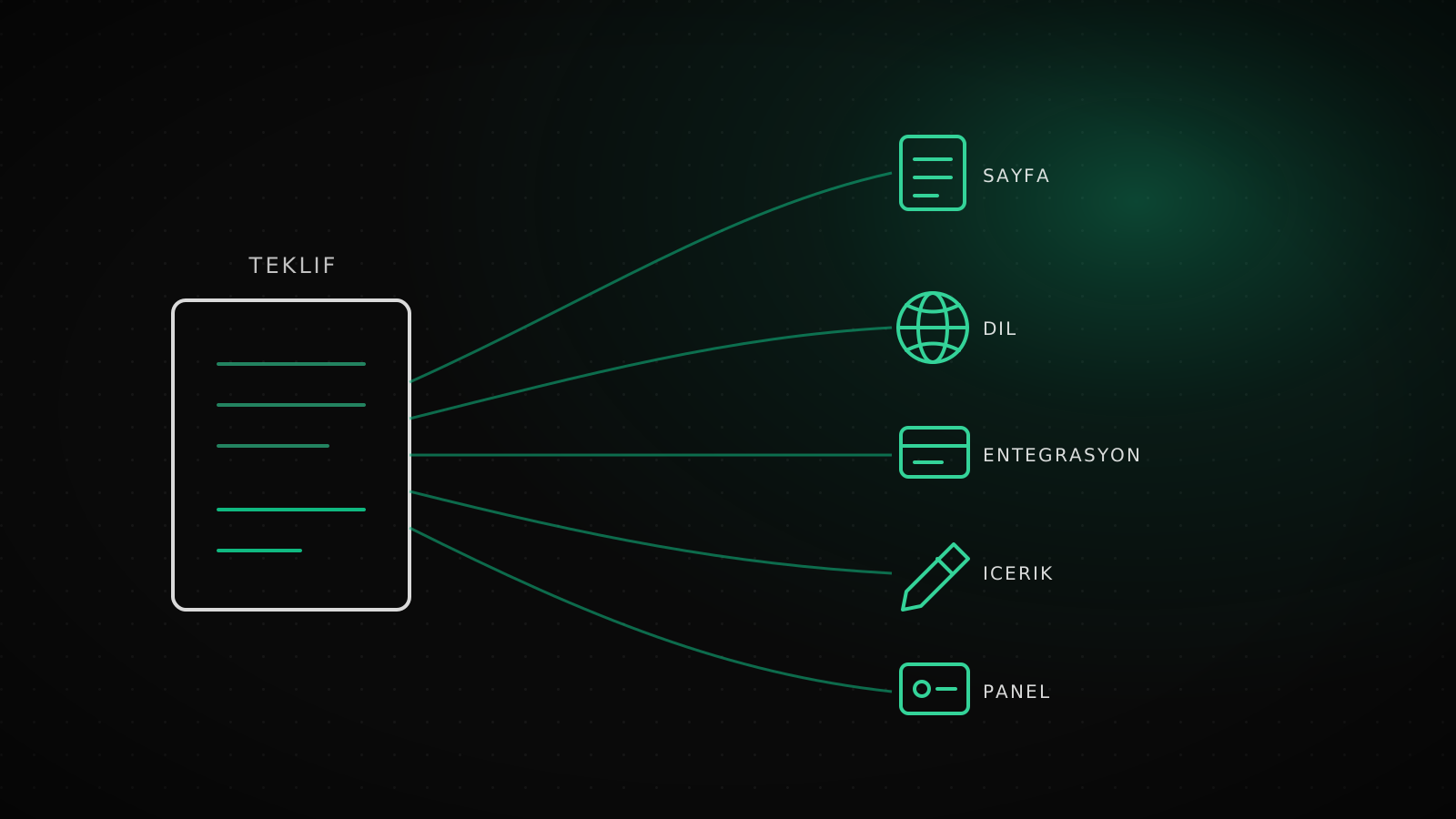
Two quotes for the same contractor website rarely differ because one agency is pricier. They differ because the scope line items are not the same. Here is what each one does to the number.
A contractor who asks three agencies for a quote usually gets back three different totals and no explanation for the gap. The honest answer is never "agency A is greedier": it's that each proposal silently picked a different answer on five scope questions, and those five questions are what actually sets the number, not the agency's margin.
Summary
Five variables move a contractor website quote: page/scope count, whether the site needs a second language, payment or e-invoice integration, who writes the content, and whether a custom admin panel is required. None of them are hidden fees; they're line items a proposal should name separately. Respect Elektrik and Wind-Mill, two real Lumiasoft builds in adjacent sectors, show how the same base scope lands differently once those five answers differ.
Same request, different total: where the number actually moves
A quote request usually starts the same way: "I need a website for my contracting firm." What a proposal returns depends on five decisions that were never asked out loud, each one answered by default rather than by choice. A page count assumed at five instead of eight. A single language assumed instead of two. No integration line because nobody mentioned e-invoicing. A content line that assumes the agency writes everything from scratch. No separate admin panel because the proposal defaults to a template CMS. Change any one of those five defaults and the total moves, which is why comparing two proposals by their bottom line alone tells you nothing about what you're actually buying.
The quote line-item table: five variables and how each one moves the number
This is the breakdown a proposal should show, even if it never does. Each row is a real scope decision, not a hidden fee.
| Variable | What it looks like in the quote | Which way it moves the number |
|---|---|---|
| Page count | Beyond the standard 5-8 page architecture: a careers page, a separate page per region, an investor section | Up, one design plus content pass per extra page type |
| Second language | TR-only versus TR+EN with its own hreflang structure, not a translate widget | Up, content and QA effort roughly double for the second language |
| Payment or e-invoice integration | iyzico or PayTR for deposits, e-fatura wiring for corporate billing | Up only if present; a pure lead-generation site with a quote form alone does not need this line at all |
| Who writes the content | The firm brings project photos and rough text versus the agency writing every page from a discovery call | Down if the firm supplies its own content; copywriting is routinely the single most negotiable line on the page |
| Admin panel | A stock CMS screen versus a custom panel built around how this firm actually adds a finished project | Up for a custom panel, but it's what lets the team add a project without calling the agency back |
Respect Elektrik and Wind-Mill: two real builds, two different scopes
Both are corporate sites Lumiasoft shipped for contracting-adjacent firms, and the gap between them is exactly the five variables above, not the agency's rate card.
Respect Elektrik
Electrical contracting, solar installation and EV charging. The scope centered on a simplified quote flow and a service-area page per line of work. Lighthouse: desktop 88, SEO 92.
Wind-Mill
Industrial ventilation and wind-energy equipment. The scope centered on a structured product catalog with technical specs per product line. Lighthouse: desktop 96, mobile 92, SEO 100.
Neither needed a second language or a payment integration; both needed a clear request-a-quote path and a page structure built around their own service lines rather than a generic "services" page. That's the pattern worth copying: the scope follows what the firm actually sells, not a fixed template.
What to look for when reading a proposal: line items or one number
A proposal that returns a single total with no breakdown is asking you to trust a black box. A proposal worth signing names the five variables above explicitly, even where the answer is "not needed, zero cost": no second language, no payment integration, template CMS is enough. That explicit "not needed" line is often the most useful one in the whole document, because it tells you the agency actually scoped the job instead of running every client through the same package.
When this line-item breakdown doesn't matter yet
A firm that only needs a single page with a phone number, an address and three photos doesn't need five negotiated line items: that's a one-page build, and asking for an itemized quote on it adds friction without adding clarity. The breakdown earns its place once the site crosses into a real project catalog, a second language, or any integration beyond a contact form. Below that line, ask for one number and move on.
Most asked when requesting a quote
Does page count alone explain most of the price gap between two quotes?
Often yes for a first pass, but the second language and the admin panel choice usually move the number more than two or three extra pages do.
Is a bilingual site worth it for a firm that only sells domestically?
Rarely. The content and QA cost of a second language only pays off once there's an actual buyer reading it: an export client, a foreign investor, a tender in English.
Does every contracting firm need a custom admin panel?
No. A stock CMS is enough until adding a finished project becomes a weekly task; at that point a panel built around the firm's own workflow saves more time than it costs.
Why would bringing your own content lower the quote?
Because writing copy from a discovery call is agency time billed by the hour, and a firm that already has project descriptions and photos removes that line entirely.
What's a reasonable timeline once the scope is set?
Lumiasoft's corporate website build ships a standard scope in two weeks once these five variables are answered; a second language or a custom panel adds to that, not to the base timeline.
For the companion checklist on what to question before signing a proposal, see what to check when requesting a contracting-firm website quote, and for what the finished site should actually contain, construction company website examples. Both sit on top of the same corporate website build this breakdown describes.
Let's talk about what you want built.
Tell us what you want to build and we will work the scope out together.
Ask an AI about Lumiasoft
The question is ready. Let the tool read the site and answer for itself.


