
Construction company website examples: what the site needs to show
Not generic inspiration photos: the five elements that actually move a construction firm's quote requests, with real examples from Mantra Yapı, Muhkem İnşaat and BRT Cabinet.
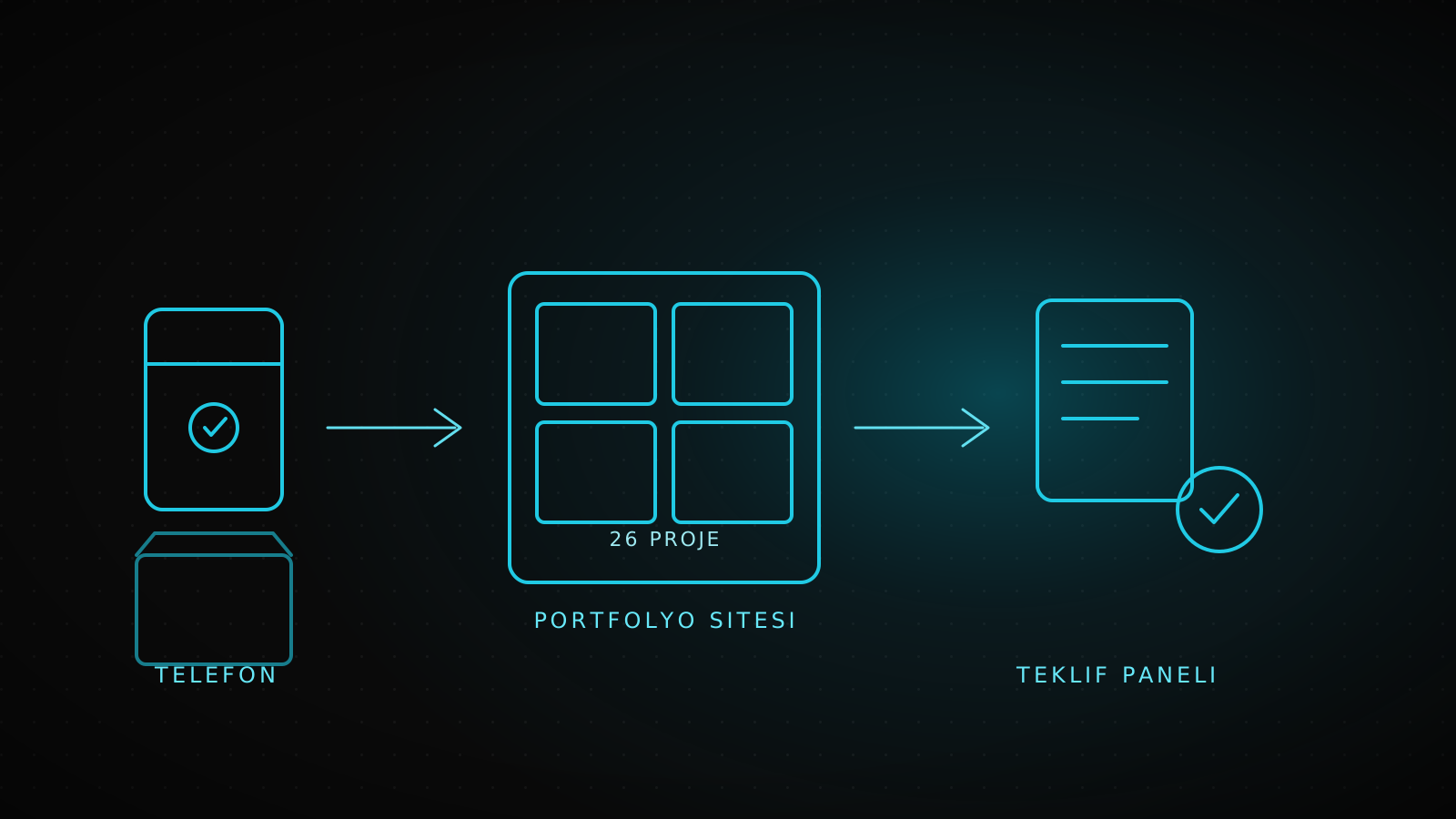
Searching for construction company website examples usually means one thing: you want to know which parts of a site actually move a visitor toward requesting a quote, not which theme looks nicest in a screenshot. The answer sits in five concrete elements: a project catalog, a completed-project counter, region and specialty pages, a bilingual structure for export buyers, and a quote form that lands somewhere a team member actually sees it. Below is what each one looks like on a real, shipped site: Mantra Yapı, Muhkem İnşaat and BRT Cabinet.
Summary
Five elements decide whether a construction firm's site actually produces quote requests: a filterable project catalog, a completed-project counter, region/specialty pages, a bilingual structure for firms selling abroad, and a quote form that lands in a panel someone checks. Three real sites below prove each one: Muhkem İnşaat's 26-project filterable gallery, BRT Cabinet's 98-Lighthouse export site, and Mantra Yapı's portfolio-first structure.
What relying on classifieds and word of mouth actually costs
Most construction and contracting firms get leads the same three ways: a listing on a classifieds portal like sahibinden, a phone number, and word of mouth from a past client. The project history that could close the next deal sits as photos in a WhatsApp folder, not on a page a prospect can open before the first call. A foreign buyer can't browse finished work before flying in. There's no quote pipeline: a request arrives by phone or DM and lives in one person's memory, not in a system anyone else on the team can see. None of this shows up on a monthly invoice, which is exactly why it survives for years: the cost is lost deals that never got logged as lost.
The 5 elements a construction site needs
Every one of these answers a specific question a prospect has before they'll pick up the phone: has this firm actually built things like mine, how many, where, and can I reach them in my own language.
What the site needs, and why it convinces
Filterable project catalog
A gallery a visitor can filter by category and status, each project with its own detail page and photos, not a single "our work" slideshow.
Completed-project counter
A real, DOM-visible count a crawler and a human both read the same way: "26 live projects" says more than any tagline.
Region and specialty pages
A page per service line and per region you actually serve: it's what lets "structural strengthening Denizli" find the firm instead of a national directory listing.
Bilingual structure
Separate TR/EN content, not a translate widget bolted onto a Turkish page. That's the difference a buyer flying in from abroad actually notices.
A quote form that lands in a system, not an inbox
Submissions that land in a panel a team can see and track, not one inbox one person checks between site visits.
How to build the project catalog: the Muhkem İnşaat example
Muhkem İnşaat is a structural-strengthening and urban-renewal contractor based in Denizli, operating since 2012 across six service lines, each with its own page. The site Lumiasoft built for them carries 26 reference projects in a gallery filterable by category and status, every one with its own detail page and photo gallery. The client manages projects, photos and text from a custom admin panel, no developer call needed to add a finished job, and published HTML is sanitized server-side before it ever reaches a visitor. First-load payload was cut from 12.7 MB to 1.6 MB by resizing images as they leave the database, which is the difference between a gallery that loads on a construction-site 4G connection and one that doesn't. See the full build on the Muhkem İnşaat project page.
Bilingual structure for firms selling abroad: the BRT Cabinet example
BRT Cabinet is a US-based custom kitchen cabinet brand, and the corporate site Lumiasoft built for it is portfolio-first in the same way: project photos and references carry the page. Lighthouse scores 98 on both mobile and desktop, and the content and language structure are built for the American market specifically, not a Turkish site with an English toggle. That distinction matters most for firms bidding on export or foreign-investor work: the English pages need their own copy, their own structure and their own proof, not a translation pass. See it on the BRT Cabinet project page.
Why the completed-project counter convinces: the Mantra Yapı example
Mantra Yapı's corporate site presents ongoing and completed projects in portfolio format, with a structure built specifically to make investor and client communication easier: project imagery and references lead, nothing else competes for attention. Technical SEO is built in from the page's first version. The real numbers across all three sites, side by side:
| Site | What it proves | Lighthouse | Catalog |
|---|---|---|---|
| Mantra Yapı | Portfolio-first corporate site | SEO 92 · Desktop 87 | Ongoing + completed projects |
| Muhkem İnşaat | Filterable catalog, admin panel | 1.6 MB first load (from 12.7 MB) | 26 projects, TR/EN |
| BRT Cabinet | Export-market bilingual structure | 98 mobile + desktop | US-market content, no TR fallback |
How the quote form should actually connect to the site
The form itself is the easy part: any contact block can collect a name and a phone number. What makes it a quote pipeline instead of a guestbook is where the submission goes next: into a panel a team can see, filter and follow up from, not one inbox one person checks between site visits. The comparison below is what actually changes:
Today
- Project photos live in a WhatsApp folder, not on a page
- A quote request is a phone call one person remembers
- No way to show a foreign buyer finished work before they arrive
- The site, if one exists, is a single untranslated page
With a portfolio site
- Filterable catalog, every project with its own detail page
- A quote form that lands in a panel the team can track
- Bilingual pages built for the buyer's own language
- Content the firm updates itself, no agency call required
When these examples don't apply yet
If a firm has fewer than roughly five finished projects it can show, a filterable gallery with filters that return one or two results looks worse than no gallery at all. A simple single-page site with a strong "about" section and direct contact details is the honest starting point, and a full catalog can follow once there's enough to fill it. If a firm's leads come almost entirely from public tenders rather than private buyers, the qualification paperwork matters more than a portfolio page, and that's a different project. Build the catalog when there's enough finished work to make it convincing, not before.
FAQ
How many completed projects does a catalog need before it's worth building?
Roughly five is the practical floor: fewer than that and a filterable gallery exposes empty categories, which reads worse than a simple one-page site.
Does a construction site really need two languages?
Only if the firm sells to, or wants to be found by, buyers outside Turkey. BRT Cabinet's English pages are written for the American market specifically, not translated from a Turkish original. That's the part that actually converts.
Why does the quote form matter more than how it looks?
Because the form itself rarely fails: what fails is the step after submission. A request that lands in an inbox one person checks is a request that can get lost; one that lands in a panel the team can filter and follow up from doesn't.
Can existing WhatsApp project photos be reused on the new site?
Usually yes as a starting point, though a catalog like Muhkem İnşaat's needed its own photo pass per project to keep load times down: 12.7 MB of unoptimized images became 1.6 MB once resized server-side.
How long does a site like this take to build?
Lumiasoft's corporate website build ships a standard 5-8 page scope, including a project catalog, in two weeks.
The three examples above came out of the same scope: a corporate website build with a CMS the client runs without calling an agency back. For the cost side of that same decision, the corporate website pricing guide and the 7 factors that set the price cover what each tier actually includes.