
Landing page vs. corporate website: when one page wins more work
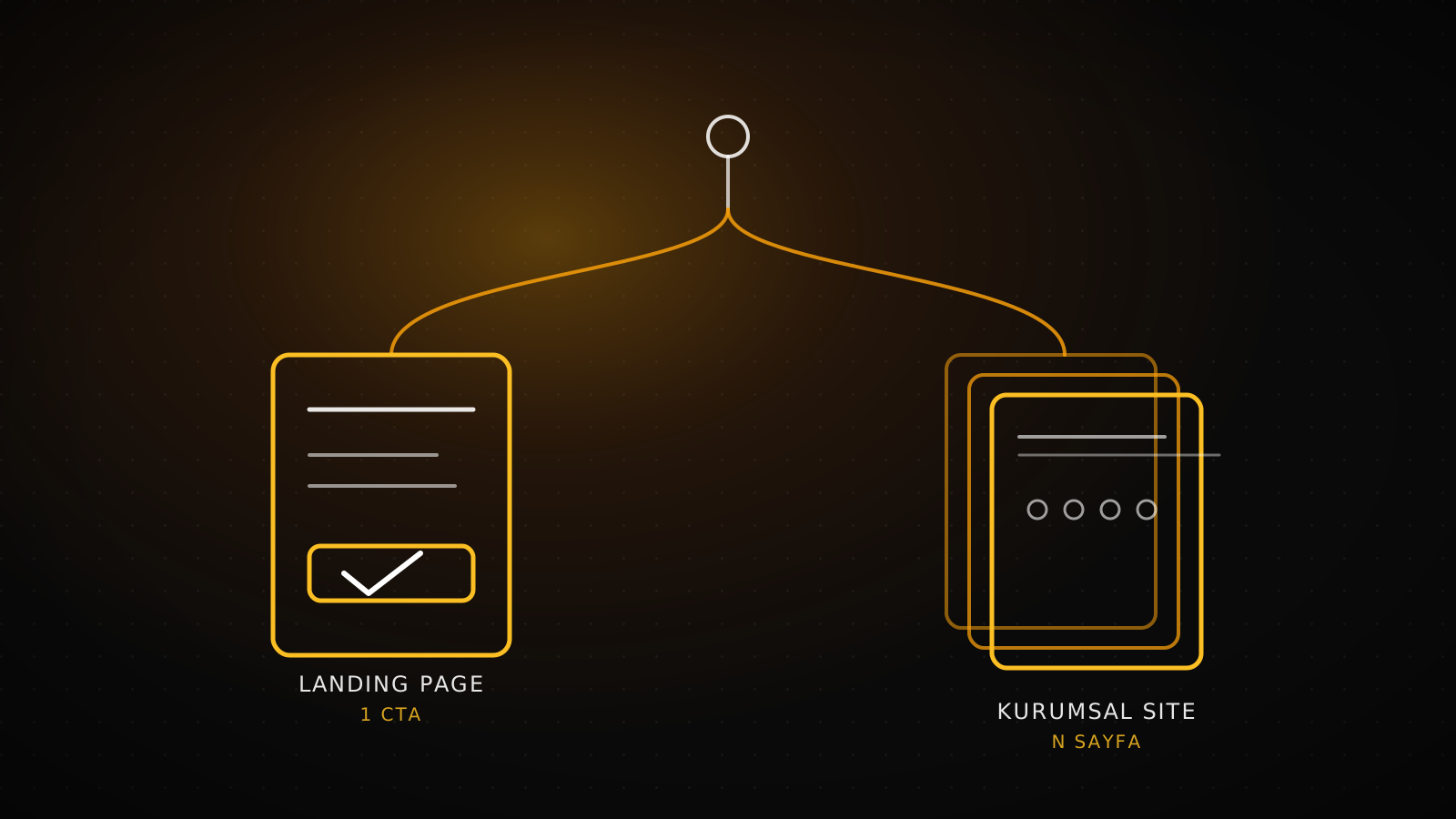
People search for landing page design and find nothing to click on this site. Here is when a single page brings more business than a full corporate site, built around a real launch project, not a hunch.
A landing page exists to sell one campaign, one product or one early-access list. A corporate website exists to carry several services, organic search and long-term trust. Using one in place of the other wastes a budget: a single-product launch drowns inside a ten-page corporate site, and a growing service list suffocates on one page built for a single pitch.
Summary
A landing page wins when traffic is paid or campaign-driven, the offer is one product or one early-access list, and the only job is one conversion. A corporate website wins when there are several services, organic search matters, and buyers need to see proof before they call. Most businesses eventually need both, built for different jobs.
What actually separates a landing page from a corporate website?
A landing page is one URL with one path through it: arrive, read one argument, take one action. Nothing competes with that action, there is no menu pulling a visitor sideways. A corporate website is a structure of pages, each answering a different question a different visitor arrives with: what do you do, who have you done it for, what does it cost, how do I reach you.
The two are not a cheaper and more expensive version of the same thing. They answer different questions, for different traffic, at different points in a buyer's decision.
A landing page wins when
- Traffic is paid ads or a campaign, not organic search.
- There is exactly one product, one plan or one launch to sell.
- The job is an early-access list or a waitlist, before the product fully exists.
- Success is one number: form fills, waitlist signups, one clear action.
A corporate website wins when
- There are several services or product lines, each needing its own page.
- Organic search is a real channel, not just paid traffic.
- The buyer needs proof before calling: past projects, credentials, a track record.
- The catalog or service list is expected to grow over the next year.
What does the site's own search data say about this question?
Lumiasoft's own Search Console account carries a clean example of the gap this decision leaves open. Over the last 28 days, queries close to "landing page design" (in Turkish: landing page tasarımı) produced impressions with no page to answer them: the site shows up in results, average position in the 20s to 40s, and gets zero clicks, because the matching page does not exist. The last standalone landing-page offer page was removed in October 2026 along with the rest of the old campaign-page section, and nothing replaced it. That is not a ranking problem; it is a missing-page problem, and it only gets fixed by building the page, not by writing more about something else.
A real one-page launch: what Voleur actually ships
Voleur is a streetwear label with no public presence before its launch site, so the whole brand story had to live on one page: what the product is, what scanning its QR code reveals, what the companion app will do once it ships. Eleven sections run from manifesto to roadmap, and every one of them points at a single conversion: the early-access waitlist. There is no pricing page, no blog, no second CTA competing for attention.
Voleur, measured
11
sections, one page
1
conversion point
90
Lighthouse mobile performance
1.7s
mobile LCP
No fake download button, no invented app screenshots: the mobile app section says "coming soon" because at launch, it was. The page is bilingual TR/EN, and particles and parallax switch off on phones and under reduced motion, since mobile is the primary surface, not a fallback.
A SaaS launch follows the same logic with a different payoff. LumiNail, Lumiasoft's own AI nail-design product, launched as a token-based platform where the single conversion is starting a trial, not reading a feature list. A product with one clear job gets a page with one clear job.
How is conversion measured on a single page?
A corporate website spreads conversion across several intents: a quote request on one page, a phone click on another, a newsletter signup on a third. A landing page has one number, so it needs one honest metric agreed before launch, not after: form fills, waitlist signups, or a single tracked click, matched to UTM source so paid and organic traffic (if any reaches the page at all) are never read as one blended number. Scroll depth and time on page are useful diagnostics for where attention drops, never the headline metric themselves.
| Criterion | Landing page | Corporate website |
|---|---|---|
| Traffic source | Paid, campaign, one channel | Organic search, referral, direct |
| What it sells | One product, one launch | Several services or product lines |
| Page count | One | Five to several dozen |
| SEO role | None expected | Primary acquisition channel |
| Conversion metric | One: form, waitlist, click | Several, tracked by page and intent |
| Update frequency | Rare, campaign-length | Ongoing, new pages over time |
When is this decision premature?
If there is no campaign budget behind it and no single product to anchor it, a landing page has nothing to sell and nothing to measure; a few honest sentences on an existing page beat a dedicated one. And a corporate website is the wrong first move for a single, time-boxed launch: it buries the one message a campaign needs under a navigation menu the visitor never asked for.
Businesses with more than one offer and a growing service list eventually need both: a corporate website as the permanent home, and landing pages for specific campaigns that point back into it. The guide to what actually drives corporate website pricing covers that broader build once scope is clear, and for firms selling into more than one country, the multilingual corporate website structure guide covers the next decision once a single-language launch has proven the idea.
Once it is clear which one the business actually needs, the corporate website solution page is where to start a scope document, whether that scope turns out to be one page or eight.
Frequently asked questions
Can a landing page rank in organic search at all?
Rarely for competitive terms: one page competing against sites with dozens of indexed pages on the same topic is a losing match. Organic search is a corporate website's job, not a landing page's.
Does a landing page need its own domain?
No. A subpath on the existing domain keeps the brand's trust and avoids starting a second domain's search history from zero, unless the campaign is deliberately detached from the main brand.
What happens to a landing page after the campaign ends?
It either gets archived with a redirect to the page that replaces it, or it stays live as a case study if the launch is worth keeping visible. Leaving it live with a dead campaign offer is the one option that actively damages trust.
Is one landing page enough for more than one audience?
No. A single page built to answer one question for one audience reads as unfocused the moment a second, different audience lands on it; a second audience earns its own page, not a shared one.
Let's talk about what you want built.
Tell us what you want to build and we will work the scope out together.
Ask an AI about Lumiasoft
The question is ready. Let the tool read the site and answer for itself.


