
iyzico vs PayTR vs Stripe: picking a payment gateway for a Turkey-based store
iyzico and PayTR do the same job for a Turkish company. Stripe is a different category: Turkey isn't on its list of supported account countries, so it only matters once a store sells across the border.
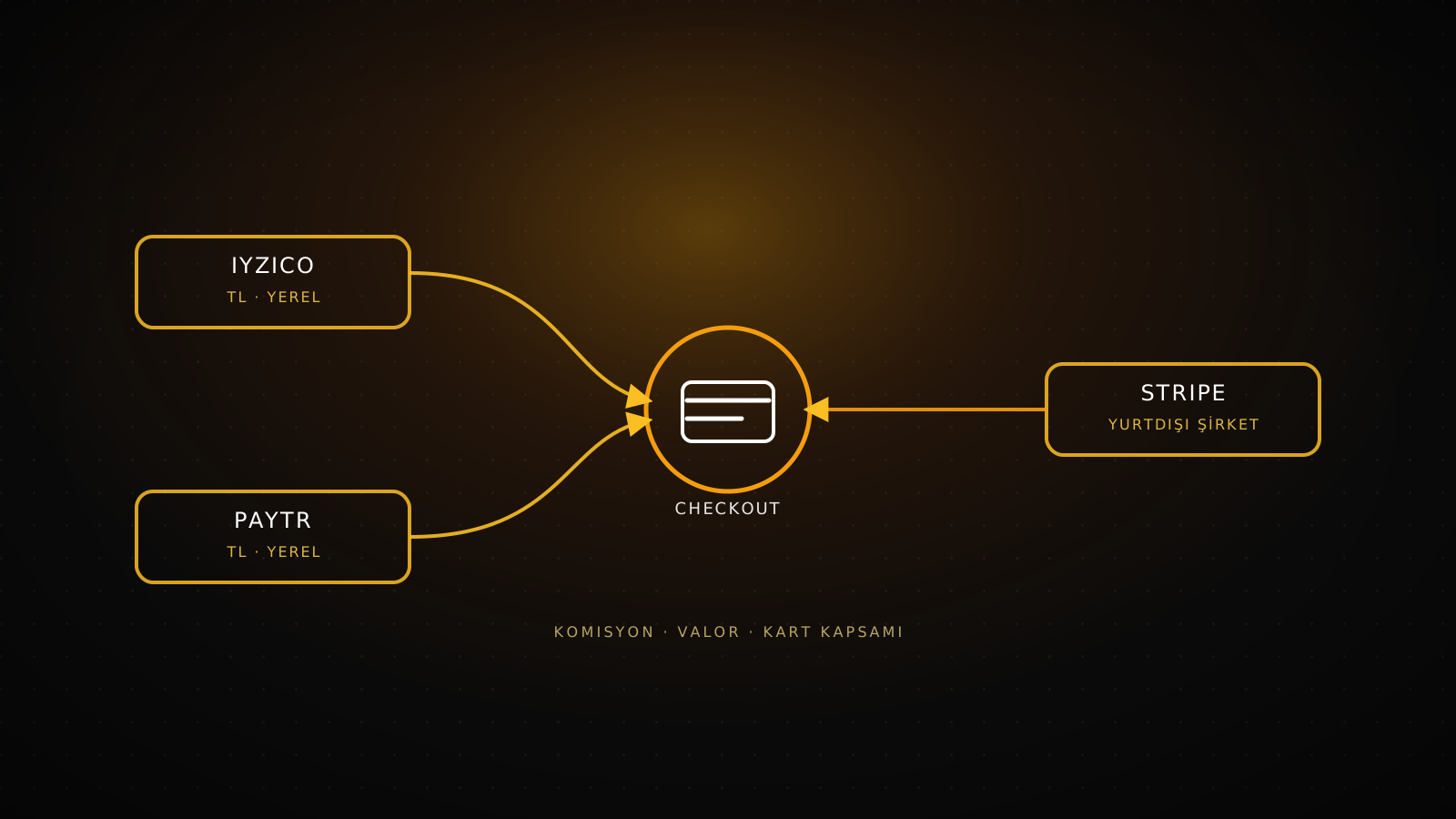
iyzico and PayTR solve the same problem for a company registered in Turkey: card payments settling in lira, with installment support across the major local banks. The real split isn't between those two, it's between both of them and Stripe. Stripe doesn't let a Turkish legal entity open a standard account at all, so it only enters the picture once a store has a foreign entity or sells to buyers abroad.
TL;DR: for a store that sells in TL to customers in Turkey, iyzico vs PayTR is a commission negotiation, not a technical decision. Stripe isn't a third local option, it's what you add once there's a foreign entity or cross-border buyers behind the storefront. Running two rails side by side, one for TL, one for export, is usually the right setup rather than a compromise.
Three providers that don't do the same job
The published fee pages don't line up cleanly, because they're not pricing the same transaction. Here's what each one actually states, as of this guide's writing:
| Provider | Fee | Payout | Installments | Cards accepted | Setup / monthly fee |
|---|---|---|---|---|---|
| iyzico | 4.29% + 0.25 TL (corporate) | Weekly, following Wednesday | 7 Turkish bank networks | TL plus USD/EUR/GBP/RUB/CHF/NOK via Sanal POS and marketplace flows | None |
| PayTR | Negotiated by volume, promotional 2.19% for new merchants | Store-specific valör; no transfers on weekends or holidays | 9 Turkish card networks | Not stated on the provider's own pricing page | None |
| Stripe | 2.9% + $0.30 (standard card rate, +1.5% on foreign cards) | Rolling, weekly or monthly, merchant's choice | None | 135+ currencies across 195 countries | None |
Stripe's numbers come from its global pricing page, not a Turkey-specific one, because Turkey doesn't have one: it isn't on Stripe's list of supported account countries. That single fact decides most of this guide.
When iyzico is the right call
iyzico fits a TL-first storefront that wants one agreement and a fixed fee structure instead of a negotiation. No setup fee, no monthly fee, a flat commission that's the same whether the store processes ten orders a month or ten thousand. Installment support covers the seven networks Turkish shoppers actually use at checkout.
- Standard WooCommerce or Next.js storefront, selling to Turkish cards.
- Monthly volume too small to negotiate a custom rate.
- Occasional foreign-currency orders through Sanal POS, no export infrastructure needed.
When PayTR is the right call
PayTR prices by relationship, not by rate card: real monthly volume and the store's business model get evaluated before a number is quoted. That makes it a better fit once a brand has enough history to negotiate, not for a store that's still validating demand. The settlement calendar is strict about weekends and public holidays, which matters for anyone modeling cash flow week to week.
- Established store with volume history to negotiate a custom commission.
- Nine-network installment coverage matters more than a documented foreign-card path.
- Comfortable with a quote-based fee, not a published flat rate.
Why Stripe can't open directly from Turkey, and when it's worth the detour
This is the fact page one of the SERP for this query gets wrong or skips entirely: Stripe's own supported-country list does not include Turkey. A Turkish company cannot register a standard Stripe account and receive payouts to a Turkish bank. The common workaround is a foreign entity, usually a US or EU subsidiary, that holds the Stripe account while the Turkish operation runs the product and fulfillment.
We've wired Stripe into two live stores: Hiera, a premium plumbing-fixtures storefront running Next.js 16 with Stripe checkout across a three-language catalog (TR/EN/ES), and LumiNail, our own AI nail-design product, where Stripe runs side by side with iyzico so token purchases clear whether the buyer's card is Turkish or foreign. In both cases Stripe wasn't a replacement for a local gateway, it was the piece that made cross-border card acceptance possible at all.
- The brand already has, or is opening, a foreign entity.
- A meaningful share of orders come from outside Turkey.
- The storefront needs a currency iyzico and PayTR don't cover.
Running all three at once
Most export-facing brands end up with two rails, not three: a local gateway (iyzico or PayTR) for TL orders, Stripe for everything that settles abroad. The storefront routes by shipping country or detected currency, not by asking the customer to pick. Our Shopify vs Next.js and platform decision guides cover the stack side of that split; the payment routing is a configuration choice layered on top, not a separate rebuild.
Which sector actually needs which gateway
Apparel and retail brands leaving a marketplace for their own store usually start with iyzico or PayTR for TL sales, then add Stripe only once a wholesale or export order shows up. Wholesale and export operations tend to need Stripe from day one, because the buyer is rarely paying in lira. A construction firm or a local clinic rarely needs any of this beyond a simple deposit link; card infrastructure for a service business is a different, much smaller build than for a catalog-driven store.
Four things that get missed during setup
- New accounts hold funds longer than the advertised payout cycle.
- iyzico doesn't support installments on foreign-currency transactions, only on TL.
- The payment gateway and the e-fatura/e-arşiv flow are separate systems.
- Every provider's webhooks need their own retry logic.
When none of this applies yet
A brand still selling only through Trendyol or Hepsiburada doesn't need any of these three. The marketplace already handles payment collection; adding a gateway only makes sense once there's a storefront of your own to connect it to. If that's the actual next step rather than this comparison, our 12-month cost comparator is the more useful place to start. For a brand that already has the storefront and is choosing the stack it runs on, our Next.js e-commerce and WooCommerce builds both wire in iyzico, PayTR and Stripe as part of the standard scope. The Hiera build is the closest reference for what the Stripe side looks like end to end.
FAQ
Can a Turkish company open a Stripe account directly? No. Turkey is not on Stripe's supported account countries list; a foreign entity is required to hold the account.
Is iyzico cheaper than PayTR? iyzico publishes a flat rate; PayTR negotiates by volume. For a small or new store, iyzico's published rate is usually easier to plan around. For an established store with volume to negotiate, PayTR can come out ahead.
Do I need Stripe if I only sell inside Turkey? No. iyzico or PayTR alone covers a TL-only storefront.
Can I switch gateways later without rebuilding the store? Yes, if the checkout was built on a standard integration rather than a gateway-specific plugin. That's a scoping question worth raising before the first integration, not after.