
Vibe coding vs. hiring a developer: the real cost comparison
The credit bill is the part you can see. The rebuild is the part that decides whether vibe coding was actually cheaper. Here's the real math, with numbers we've already published.
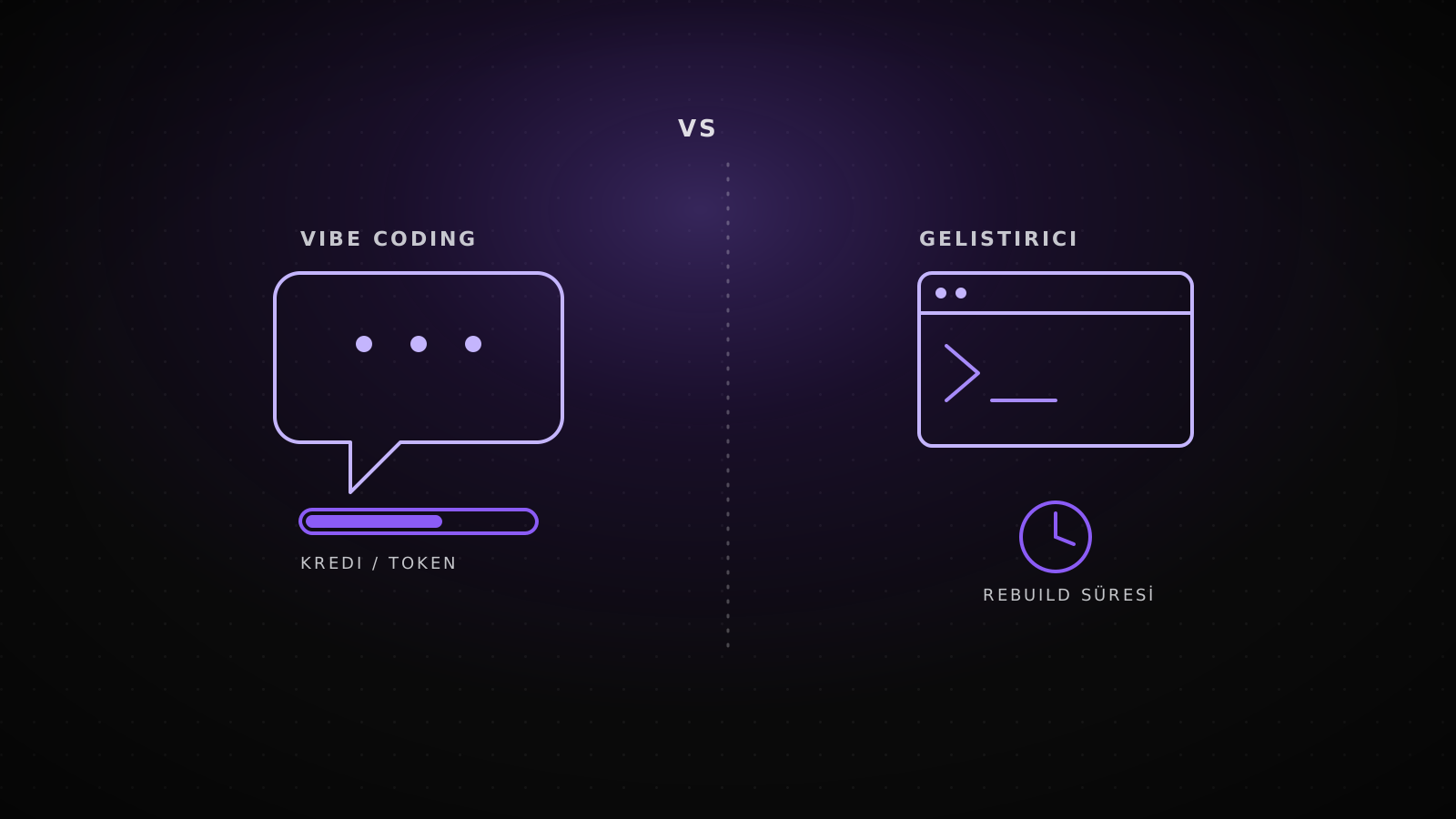
For a project with no real users and no payment flow, vibe coding alone is almost always cheaper: the bill tops out at a monthly subscription. The moment the project takes payment, holds accounts, or touches a third-party API with a key that can't leak, the comparison flips, because the cost that decides the outcome is not the credit bill, it's the rebuild. Below is the actual math on both sides, using numbers we've already published rather than invented ones.
TL;DRVibe coding's visible cost is $20-30/month in credits or tokens. Its invisible cost shows up only if the project needs a rebuild, and that rebuild runs three days to six weeks depending on what's underneath. Hiring a developer or agency from day one costs more up front and less in total the moment auth, payments, or a leak-sensitive API key enter the picture. Below is where that line sits by project type.
Vibe coding's visible cost: the credit and token bill
We priced this directly from each tool's own published numbers, in our cost calculator and the pricing breakdowns linked below, not from an estimate:
- Lovable prices a small edit like "make the button gray" at 0.50 credits and a feature like "add sign up and login" at 1.20-1.70 credits. A Pro plan buys a fixed monthly credit pool; run out mid-month and you're paying for top-ups or waiting for the reset.
- Bolt.new meters usage in tokens: 1 million a month and 300,000 a day on the free plan, 10 million a month on Pro. A single feature pass on a mid-size app can burn six figures of tokens by itself.
- Cursor doesn't publish a fixed request count at all. What you burn depends on the model you pick, so its own pricing language is relative: Pro, Pro+ at 3x the usage, Ultra at 20x.
These figures were current as of 2026-08-29; all three vendors change pricing often, so treat the calculator link as the live source and this paragraph as the shape of the bill, not today's exact number. Either way, the pattern holds: for a solo builder working evenings, the visible side of vibe coding lands in the $20-30/month range before anything breaks.
Vibe coding's invisible cost: the rebuild
The invisible cost only appears when something has to be redone, and it's the part a credit calculator can't show you because it isn't metered in tokens. Our own AI project completion work, which exists specifically to take over stalled AI-built codebases, quotes this range plainly: two projects that look identical from the outside can differ completely underneath, one is three days of work, the other is six weeks. The variable isn't the tool, it's what the project actually needs once real users show up: a login system that survives concurrent sessions, a database that isn't readable by anyone with the URL, a payment flow that reconciles instead of just "working in the demo."
A project that never needed that layer pays nothing extra. A project that needed it from day one and didn't get it pays the rebuild price, on top of whatever credits were already spent getting to the point of needing it.
Where a developer or agency's cost actually comes from
We don't quote a fixed number here, for the same reason our corporate pricing breakdown and our mobile app cost breakdown don't: the figure shifts by market and moves fast enough that a specific dollar amount would be stale before this page finishes indexing. What's stable is what drives it up, in order:
- Authentication and session handling done for real traffic, not a demo. This is the single most underestimated line item in a vibe-coded project.
- Payments that reconcile. Taking money is easy. Refunding it, handling a failed webhook, and matching what the processor says against what your database says is the actual work.
- Data access control. Row-level security or equivalent, scoped per user, not "the API key has access to everything."
- Third-party integrations with a secret that can't leak. Every external API key is a liability the moment it's client-side.
- How much of the existing code survives. Often the interface stays and only the data and security layers get rebuilt; sometimes starting over costs less, and an honest quote says so instead of billing for a rescue that isn't worth it.
A project with none of these is close to free to hire for, because there's barely anything to hire for. A project with three or four of them is where the quote climbs, not because of page count or feature count, but because each one is a place real users can break something a demo never tested.
Which is cheaper, by project type
| Project type | Vibe code it yourself | Hire from day one |
|---|---|---|
| Internal tool, no real users, no payment | Cheaper and sufficient. The $20-30/month bill is the whole cost. | Overkill. You're paying for risk that doesn't exist here. |
| MVP with accounts or an external API key, scope still moving | Fine to start, risky to ship as-is. Validate the idea here, then hand off before launch. | Premature. You'd be paying for production hardening on a product that might pivot. |
| Real users, payments, or two-plus blind spots at once | The credit bill looks cheap right up until the rebuild bill arrives, three days to six weeks later. | Costs more up front, less in total. This is where the line actually sits. |
The middle row is the one people get wrong most often, which is why it's its own row and not a footnote: scope that's still moving is exactly when a full handoff is premature, and exactly when shipping an unvalidated blind spot to real users is expensive in a different way.
The four signals that move you to "hire"
Our build-vs-hire calculator scores five questions, but the result tips on four specific blind spots, and when two or more land on the same project at once, the honest answer is to hire before writing another feature: authentication, live or sensitive data access, secrets and keys, and payments. A simple internal stock tracker with none of these is a legitimate "do it yourself, forever" project. The same tool, opened to the public with payments added, is a different project with a different cost structure, even though the code looks similar on both days.
The hybrid path: running both at once
The middle option isn't a compromise, it's often the correct sequence: vibe code the prototype to validate the idea cheaply and fast, then hand off the production layer before real users arrive, not after. This is where the handoff is cheapest, because nothing has broken yet, there's no incident to diagnose, and no "temporary" workaround has calcified into the architecture. Waiting until something fails in production to call for a handoff is what turns a three-day job into a six-week one.
When this comparison stops applying
If the project genuinely never leaves your own hands, never takes a payment, and never touches another person's data, none of this math matters, and paying for a developer would be solving a problem you don't have. The comparison above is for the moment a project starts talking to real users, real money, or someone else's data. Before that line, vibe coding alone is not a compromise, it's the correct tool.
If you're past that line and the credit bill no longer tells the whole story, our AI project completion team reads the code first and quotes after, not before.
FAQ
Is vibe coding always cheaper at the start? Yes, for the first weeks, because the only cost is the subscription. The question is what happens the week real users show up.
How much does the rebuild actually cost? We don't publish a fixed number because it depends on what's underneath, not on the tool used. Our own quoted range is three days to six weeks of work once we've read the code.
Can I avoid the rebuild entirely? Only if the project never needs the four blind spots above. If it does, the rebuild cost is already baked in, whether you pay it now or later.
Is hybrid the same as "hire later"? No. Hybrid means handing off before launch, while the prototype still works and nothing has failed yet. Waiting until after launch is what makes the handoff expensive.